
Commercial Warehouse Flooring: Minimizing Downtime While Maximizing Durability
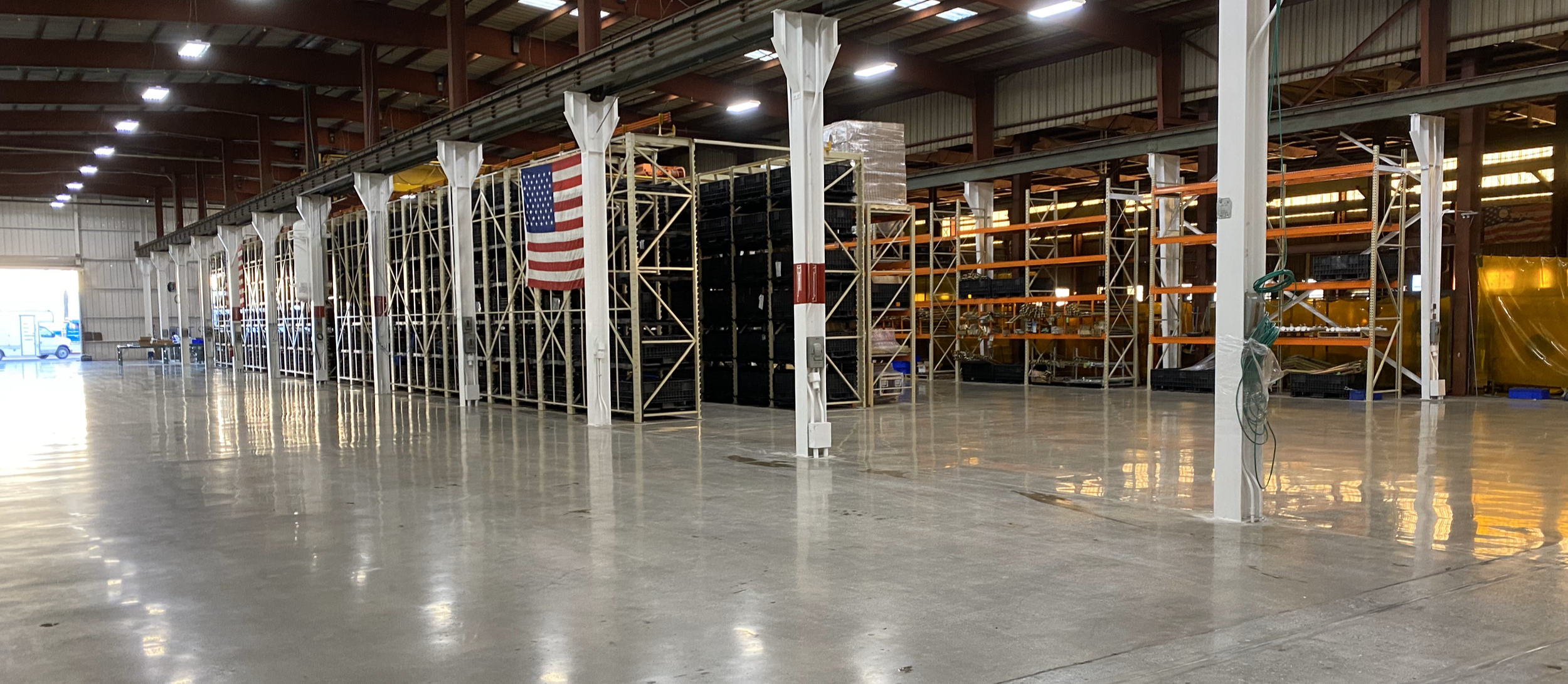
A 50,000 sq ft warehouse shutdown costs approximately $2,000-$5,000 per day in lost productivity, delayed shipments, and operational disruption. For a distribution center or e-commerce fulfillment facility, that number can exceed $10,000 per day.
So when your warehouse floor needs repair, coating, or refinishing—and your contractor tells you "expect 5-7 days of downtime"—that's a legitimate concern. A week-long closure could cost you $10,000-$35,000 in lost operation, not counting the coating itself.
The question becomes: How do you get a durable, professional warehouse floor without shutting down your operation for a week?
The answer lies in understanding your options, planning smart, and working with a contractor experienced in minimizing operational impact.
The Cost of Warehouse Floor Failure
Before we talk about solutions, understand why waiting isn't an option:
Poor warehouse flooring creates:
- Safety hazards: Cracked, uneven, or dusty concrete increases slip/fall risk, liability exposure
- Equipment damage: Rough concrete accelerates tire wear on forklifts and pallet jacks
- Air quality issues: Unsealed concrete generates dust that contaminates products and affects worker health
- Operational inefficiency: Damaged floors slow equipment movement, increase maintenance on machinery
- Facility degradation: An unprofessional floor signals poor facility management to customers, partners, tenants
A facility manager we worked with in Anaheim described it this way: "Our warehouse floor was deteriorating. Concrete dust was getting into product boxes. We were getting customer complaints. Equipment damage was rising. We knew we had to act, but we couldn't afford to shut down."
That's when planning becomes critical.
Understanding Your Downtime Constraints
The first step is honest assessment: How much downtime can your operation actually tolerate?
Different warehouse types have different flexibility:
- E-commerce fulfillment: Typically zero tolerance for downtime (high daily costs)
- Traditional warehouses: May have 2-3 day flexibility during slower periods
- Manufacturing facilities: Often have planned maintenance windows (weekends, holidays)
- Distribution centers: May rotate work to secondary facilities during closure
- Retail warehouses: Seasonal windows (post-holiday, pre-peak season)
Once you know your tolerance, you can evaluate flooring solutions that fit.
Option 1: The Weekend Installation (Minimal Disruption)
Timeline: Work Friday evening through Sunday evening
Operational impact: Loss of 1.5-2 days of operation
Best for: Facilities with flexible schedules or seasonal downtime
For many warehouses, the solution is scheduling flooring work over a compressed weekend timeline.
Here's how it works: Your contractor begins Friday evening after your operation closes. Working around the clock (yes, truly 24-hour crews exist), they complete the full project—grinding, repair, coating application, and curing—by Sunday evening.
Your facility opens Monday morning with a new floor.
The economics:
- 1.5 days lost ≈ $3,000-7,500 in operational costs (vs. $10,000-35,000 for a full week)
- Installation cost is higher due to overtime labor
- Net savings still favors compressed timeline for high-downtime-cost facilities
PolyVex's advantage: Our Terrco 6200 orbital grinder is commercial-grade equipment that works faster and more efficiently than standard contractors' tools. This means we can accomplish more work in the compressed timeframe.
Option 2: The Phased Approach (Ongoing Operation)
Timeline: 2-3 week schedule, minimal disruption each day
Operational impact: Reduced access to specific zones; operations continue in other areas
Best for: Large facilities that can adjust layout during the project
Instead of closing the entire warehouse, you close specific zones or sections at a time.
Example: A 50,000 sq ft warehouse divides into 4 sections. Week 1, section A is down for flooring work while sections B, C, and D operate normally. Operations adjust routing and vehicle paths. The following weeks, sections B, C, and D are serviced in rotation.
By the end of month 3, the entire facility has new flooring, but you've never fully closed.
The challenge: This requires careful planning. Your contractor must coordinate with your operations team to avoid disrupting critical workflows. It's doable but demands communication.
Option 3: The Quick Grind & Seal (Fastest Option)
Timeline: 2-3 days, facility operational with limited restrictions
Cost: Lowest price option ($2-3/sq ft)
Best for: Budget-conscious facilities or temporary solutions
If timeline is critical and budget is tight, grind & seal is your fastest path.
The process: Grind, clean, seal. That's it. Two days of work, facility operational with light-traffic-only restrictions on day 3, full operation by day 4.
It's not the longest-lasting solution (5-8 year lifespan vs. 10-15 for epoxy), but it buys you time and improves the floor immediately.
Many facility managers use grind & seal as a "bridge" solution—get the floor sealed and protected now, plan for a longer installation (epoxy or polished concrete) during a planned maintenance window later.
Option 4: Holiday/Seasonal Windows (Best Long-Term Solution)
Timeline: 5-10 days during planned downtime
Cost: Full range ($2-9/sq ft depending on system)
Best for: Facilities with predictable seasonal patterns
Retail warehouses, e-commerce facilities with seasonal peaks, and manufacturing plants with scheduled shutdowns can leverage built-in downtime.
Examples:
- Post-holiday retail: December 26-January 10 window for warehouse closure
- Manufacturing: Summer shutdown or maintenance week
- E-commerce: Post-peak-season slowdown
During these windows, you can pursue the full installation: epoxy flooring, polished concrete, or comprehensive repair. No rushed timeline, no weekend premium labor, no phased approach complications.
This strategy delivers the best long-term durability because there's no pressure to rush through proper preparation.
Planning Your Warehouse Floor Project: A Timeline Framework
Months 1-2: Planning & Assessment
- Month 1: Have a contractor assess your floor condition. Get quotes for your preferred solution (epoxy, polished concrete, or grind & seal).
- Month 2: Secure budget approval. Coordinate with operations to identify your downtime window.
Month 3: Logistics & Preparation
- Confirm details with your contractor: exact scope, timeline, crew size, equipment requirements
- Prepare your facility: Remove equipment from work areas, plan traffic rerouting, brief your team
- Schedule notifications: Alert tenants, customers, shipping partners of any access restrictions
Month 4: Installation
- Execute project: Follow your planned downtime approach (weekend, phased, seasonal, or quick seal)
- Minimal surprises: Proper planning means contractors aren't discovering hidden damage mid-project
- Document results: Photograph the finished floor for records and insurance purposes
Months 5+: Maintenance & Monitoring
- Establish maintenance schedule: Quarterly cleaning, annual inspections, periodic burnishing (if polished concrete or epoxy)
- Track performance: Monitor floor condition and plan refreshes before failure
Real-World Example: How One Anaheim Warehouse Minimized Downtime
A 35,000 sq ft distribution center in Anaheim needed their warehouse floor coated. The facility operated 6 days/week and couldn't afford full closure.
Their solution: Phased approach over 3 weeks, with 3 sections down at a time while the main operation shifted to the remaining section.
The timeline:
- Week 1: Close section A (10,000 sq ft), operations adjust to sections B & C
- Week 2: Close section B while A cures, operations in sections A & C
- Week 3: Close section C, operations in sections A & B
The result: All 35,000 sq ft coated with industrial-grade epoxy. Facility never fully closed. Downtime cost: ~$6,000 (vs. potential $25,000-35,000 for full closure). Installation quality: Professional, no shortcuts.
Operations was pleased. Management was pleased. The facility now has a durable floor rated for another 10-15 years.
The Role of Your Contractor in Downtime Minimization
Not all flooring contractors are equipped to handle compressed timelines or phased approaches. Here's what separates the pros:
Equipment matters:
- Standard contractors use walk-behind grinders (slow, cover limited area)
- Professional contractors use Terrco-class orbital grinders (faster, larger area coverage)
- This difference compounds over a compressed timeline
Experience matters:
- Contractors experienced with warehouse projects understand operational constraints
- They can coordinate with your team to minimize disruption
- They plan contingencies for unexpected discoveries
Crew capacity matters:
- A small crew might need 2 weeks for work a larger crew completes in 3 days
- Weekend work requires 24-hour scheduling capability
Choosing the Right Flooring Solution for Your Downtime Reality
Your facility's downtime tolerance should drive your flooring choice:
Zero-tolerance for downtime?
→ Grind & Seal (2-3 days) or Weekend Installation (Friday-Sunday)
Can lose 1 week?
→ Epoxy Flooring (3-5 days) during planned shutdown
Can lose 2-3 weeks?
→ Polished Concrete (5-10 days) with optimal preparation or phased approach
Can leverage seasonal downtime?
→ Any system; maximize quality since timeline isn't constrained
Your Next Step: Get a Customized Project Plan
Every warehouse is different. Your downtime tolerance, facility size, current floor condition, and budget all shape the right approach.
We recommend a free on-site assessment where we:
- Evaluate your current floor condition
- Discuss your operational constraints and downtime tolerance
- Recommend the best flooring solution (epoxy, polished concrete, or grind & seal)
- Provide a realistic timeline that minimizes your operational impact
- Walk through project logistics with your operations team
No surprises. No hidden costs. Just honest planning that gets your warehouse a professional floor without unnecessary downtime.
Ready to minimize your downtime and maximize your floor durability?
Get a customized project plan from warehouse flooring experts.
Call (714) 584-9106 Request a Free Assessment