
Epoxy vs. Polished Concrete vs. Grind & Seal: Which Commercial Flooring is Right for Your Facility?
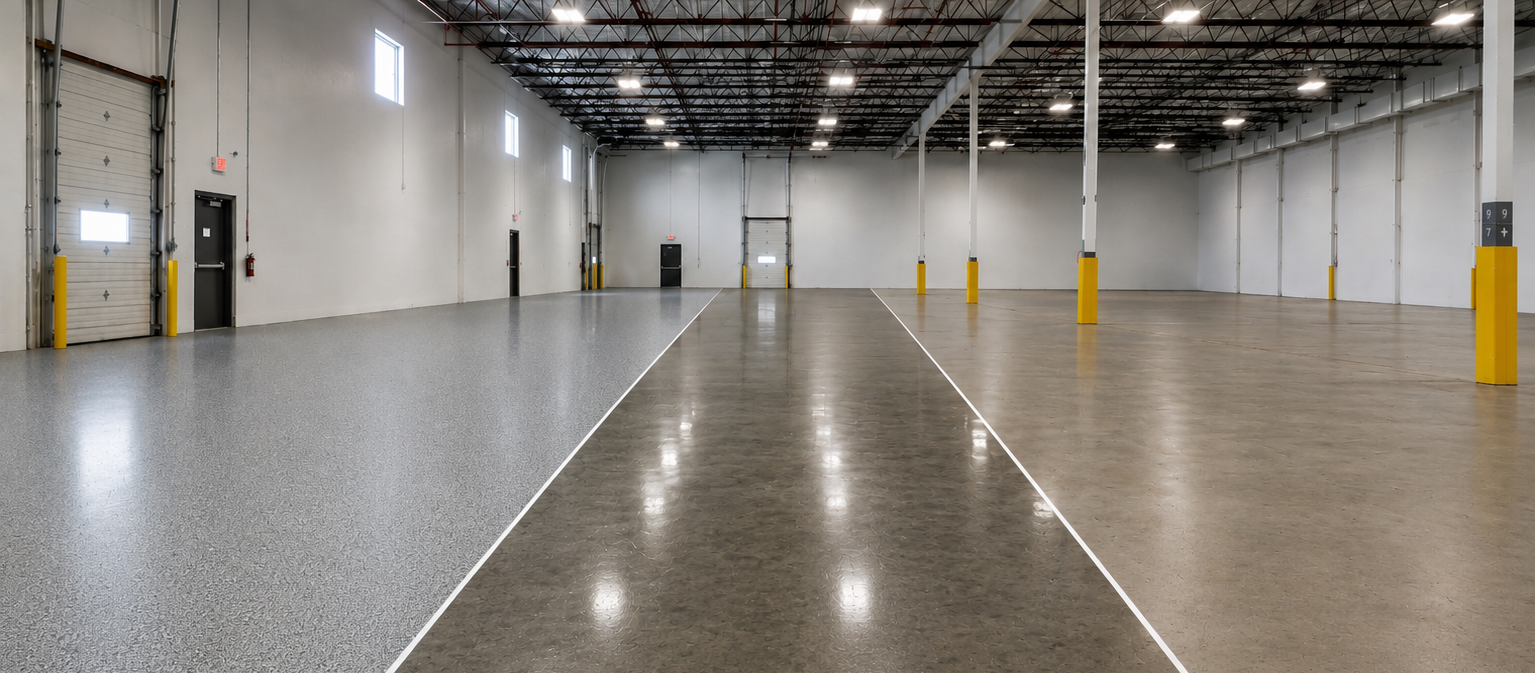
Choosing flooring for a warehouse, retail space, manufacturing facility, or commercial office isn't one-size-fits-all—and the wrong choice can cost you in premature replacement, operational downtime, or liability.
If you manage facilities across Orange County, you've likely gathered quotes for epoxy flooring, polished concrete, and grind & seal. The timelines differ, the pricing varies, and the promises sound similar. So how do you actually decide? This guide breaks down each system so you can match the right one to your facility, budget, and operational constraints.
A note on pricing: this guide compares systems in relative terms rather than quoting per-square-foot figures. Real pricing depends on slab condition, square footage, prep required, and finish selected—and improves with job size. We provide firm numbers after an on-site assessment.
What Makes a Flooring Solution "Commercial-Grade"?
Before comparing systems, it's worth understanding what separates professional commercial flooring from DIY or residential approaches.
Professional systems use:
- 100% solids epoxy or industrial-grade sealers (not water-based)
- Proper surface preparation through mechanical diamond grinding
- Multi-layer application (primer, base coat, topcoat or polishing sealer)
- UV-stable, slip-resistant finishing layers where specified
- Industrial-grade equipment—in our case, a Terrco 6200 orbital grinder
- Proven performance under heavy traffic, chemicals, and machinery
Why this matters: DIY kits and residential contractors routinely cut corners on preparation, which is the leading cause of early failure. Proper prep is the difference between a floor that lasts a couple of years and one that serves a decade or more. And in a commercial setting, worker safety and liability depend on a documented, compliant installation.
Epoxy Flooring: Durability, Aesthetics, and Chemical Resistance
Relative cost: Premium tier · Installation: 3–5 days typical · Service life: 10–15 years with maintenance · Cure: ~72 hours before vehicle/equipment traffic, ~7 days for full cure
When Epoxy Makes Sense
Epoxy suits facilities where durability, appearance, and chemical resistance all matter:
- Warehouses and distribution centers with forklifts, pallet jacks, and spill exposure
- Retail showrooms where floor appearance reflects brand quality
- Auto dealerships wanting high gloss and color matching
- Manufacturing facilities needing slip resistance and chemical durability
- Commercial kitchens and food service requiring sanitizable surfaces
- Automotive service bays handling oils, brake fluid, and heavy equipment
Why Industrial-Grade Epoxy Outperforms Alternatives
A 100% solids epoxy applied over properly diamond-ground concrete creates a mechanical bond—the coating keys into the concrete's pores rather than simply sitting on the surface. That's why professional epoxy survives hot tire pickup, thermal cycling, and chemical exposure that would destroy painted concrete or a water-based kit.
The key is preparation. We diamond-grind every floor we coat to establish a proper surface profile. Skip that step and even premium epoxy will eventually peel—which is precisely why so many big-box DIY kits fail early.
Pros
- Highly customizable: Wide range of color blends, chip densities, and finishes
- Durable under machinery: Handles forklift traffic, heavy loads, thermal shock
- Chemical resistant: Withstands oils, solvents, acids, and common industrial chemicals
- Easy to clean: Mop and occasional power wash; no specialty equipment
- Safety options: Slip-resistant additives available; bright colors can mark equipment zones
Cons
- Premium upfront cost: Substantially more than grind & seal
- Longer installation: 3–5 days, though most facilities can schedule around it
- Cure time: Forklift traffic can't resume until roughly 72 hours after topcoat
- Periodic maintenance: Topcoat reapplication every 3–5 years extends life and maintains gloss
Polished Concrete: Longest Service Life and Sustainability Fit
Relative cost: Premium tier · Installation: 8–10 days per ~10,000 sq ft · Service life: 20+ years with periodic burnishing · Maintenance: Burnishing and sealer reapplication every 2–3 years
Polished concrete is the process of diamond-grinding concrete to progressively finer grits, then applying a penetrating densifier that hardens the surface itself—not a coating on top. The result is a hard, reflective, low-maintenance floor.
Best Applications
- Corporate offices and showrooms seeking a modern, professional aesthetic
- Retail spaces wanting high-gloss reflectivity without a heavy maintenance burden
- Auto dealerships displaying high-end vehicles
- Warehouse showrooms combining durability with premium appearance
- LEED-oriented projects pursuing low-emitting materials credits
- Food service and restaurants requiring hygienic, easy-to-clean surfaces
Why Polished Concrete Is Gaining Ground
- Sustainability: Under LEED v4/v4.1, concrete is recognized as an inherently non-emitting source of VOCs—provided the floor has no organic-based coatings, binders, or sealants. A true mechanical polish fits that description; adding a solvent-based sealer moves the product into the Paints & Coatings evaluation instead. It also uses the slab already in place, avoiding the replacement cycles of applied floor coverings.
- Long-term cost: Where epoxy typically serves 10–15 years, polished concrete can run 20+. Spread over that horizon, its cost per year of service is often the lowest of the three.
- Light reflectivity: A light-colored polish is highly reflective, which brightens a space and can support daylighting and lighting-energy strategies. How much it actually reduces lighting load depends on the finish, color, and your building's lighting design—that's modeled by your design team, not guaranteed by the floor.
- Minimal maintenance: Water, a pH-neutral cleaner, and periodic burnishing.
- Durability: The concrete itself is hardened and densified, so it handles forklifts, machinery, and heavy foot traffic well.
Pros
- Longest service life of the three when maintained
- Supports sustainability goals and can contribute toward LEED credits (confirm specifics with your LEED AP)
- Low maintenance relative to carpet, tile, or coated systems
- Premium appearance with genuine light reflectivity
- Uses the existing slab—one installation instead of repeated replacement cycles
Cons
- Longest installation timeline of the three
- Can be slippery when wet: Anti-slip options exist but add cost and can reduce gloss
- Requires ongoing maintenance: Burnishing on schedule is essential to performance
- Not ideal for aggressive chemicals: Oils and strong chemicals can stain if not cleaned promptly
Grind & Seal: The Cost-Effective, Fast-Turnaround Option
Relative cost: Baseline—roughly a third of the premium systems · Installation: 2–3 days per ~2,000 sq ft · Service life: 5–8 years · Maintenance: Occasional power washing, sealer reapplication every 3–4 years
We mechanically grind the slab to remove surface contamination, old coatings, and dirt, then apply a penetrating sealer that hardens the surface and resists moisture, oils, and dust. It isn't as visually striking as polished concrete or as durable as epoxy—but it delivers solid protection and a professional appearance at the lowest price point.
Best Applications
- Warehouses and distribution centers where budget is the binding constraint
- Fleet facilities and truck yards needing quick, cost-effective treatment
- Secondary spaces: loading docks, back-of-house, secondary warehouses
- Leased or temporary facilities without a 10+ year occupancy horizon
- Multi-location operators needing coverage across many buildings
- Quick-turnaround projects where a 2–3 day window is critical
The Economics of Grind & Seal
Grind & seal typically runs roughly a third of what epoxy or polished concrete cost upfront. For an operator managing several Orange County facilities, that difference is the whole appeal: the same capital that would treat one or two buildings with a premium system can cover the entire group.
The trade-off is service life. A grind & seal floor generally lasts 5–8 years before it needs resealing—at which point you can reseal again or upgrade to epoxy or polished concrete. Many facility managers use it deliberately as a placeholder for buildings they don't plan to hold long-term, or as a low-cost refresh for secondary facilities.
Pros
- Lowest upfront cost of the three by a wide margin
- Fastest installation—minimal operational disruption
- Effective dust control: Eliminates concrete dusting and improves air quality
- Moisture resistant: Sealer blocks water and vapor
- Better oil and chemical resistance than unsealed concrete (though not epoxy-level)
Cons
- Shortest service life: More frequent refresh cycles over the long run
- Less striking appearance: Professional, but not premium
- Periodic resealing every 3–4 years
- Can be slippery when wet
- Not ideal for the heaviest traffic: Machinery and intense foot traffic degrade the seal faster
Side-by-Side Comparison
| Factor | Epoxy Flooring | Polished Concrete | Grind & Seal |
|---|---|---|---|
| Relative upfront cost | Premium tier | Premium tier | Baseline (~1/3 of premium) |
| Installation time | 3–5 days | 5–10 days | 2–3 days |
| Service life | 10–15 years | 20+ years | 5–8 years |
| Relative cost per year of service | Competitive | Often lowest over a long hold | Competitive, but reseal cycles add up |
| Appearance | High-gloss, customizable | Reflective, premium | Clean, matte, professional |
| Chemical resistance | Excellent | Good | Fair to good |
| Slip resistance | Excellent (anti-slip options) | Moderate (aggregate can be added) | Minimal |
| Maintenance | Topcoat reapplication every 3–5 yrs | Burnishing every 2–3 yrs | Reseal every 3–4 yrs |
| LEED contribution | Limited — evaluated under Paints & Coatings | Strongest — inherently non-emitting when finished without organic coatings | Depends on the sealer specified |
| Best for | Warehouses, showrooms, manufacturing | Offices, sustainability-focused projects, premium retail | Budget-constrained and shorter-horizon facilities |
A Decision Framework for Facility Managers
Step 1: Assess Your Timeline
- Operating this facility 10+ years? → Epoxy or polished concrete
- 5–8 years or uncertain? → Grind & seal
- Appearance is mission-critical? → Polished concrete or epoxy
Step 2: Evaluate Budget Constraints
- Must minimize upfront cost or cover many buildings? → Grind & seal
- Can invest for 10–15 year durability? → Epoxy
- Long-term value and sustainability are priorities? → Polished concrete
Step 3: Consider Your Environment
- Heavy forklift traffic, oils, chemicals? → Epoxy (industrial-grade)
- Showroom or high-traffic retail? → Polished concrete or epoxy
- Secondary spaces, loading docks? → Grind & seal
- Sustainability or LEED goals? → Polished concrete
Step 4: Factor in Operational Downtime
- Can't lose more than 2–3 days? → Grind & seal
- Can plan a 3–5 day window? → Epoxy
- Can coordinate a 5–10 day project? → Polished concrete
Step 5: Think in Cost Per Year, Not Just Upfront
The most common budgeting mistake is comparing only upfront numbers. Spread each system across its actual service life and the picture changes: grind & seal's large upfront advantage narrows considerably, and polished concrete often comes out lowest per year of service for facilities planning a long hold. Grind & seal still wins decisively on capital efficiency—protecting more square footage now—which is a different and equally valid reason to choose it.
Why Preparation Matters More Than the Finish
Whichever system you choose, installation quality depends overwhelmingly on surface preparation.
A poorly prepared surface will fail early no matter how premium the epoxy or polishing system on top of it. This is why facilities so often have bad experiences with low-cost contractors—the diamond grinding step is where corners get cut, because it's the least visible part of the job.
We diamond-grind every floor we coat. It's non-negotiable, because proper preparation:
- Removes old coatings, oils, and contaminants
- Opens the concrete's pores for a mechanical bond
- Creates a consistent surface profile
- Ensures the finish—epoxy, polished, or sealed—actually adheres and lasts
That single step is most of the difference between an early DIY failure and a professional floor that serves a decade or more.
Getting the Right Recommendation for Your Facility
The best solution depends on your specific facility, budget, operational timeline, and maintenance commitment. We serve all of Orange County and surrounding Southern California, and we're transparent about costs, timelines, and long-term maintenance requirements—no pressure, no surprises.
Free Orange County Facility Assessment
Not sure which system fits your facility? PolyVex Surface Solutions will evaluate your floor's current condition, understand your operational constraints, and recommend the option that delivers the best value for your situation.
Call (714) 584-9106 Request a Free Quote