
LEED-Compliant Flooring: Achieve Sustainability Goals with Polished Concrete
Your Orange County commercial project is pursuing LEED certification, and flooring is on the decision list. A fair question from the sustainability team: does the floor choice actually help—or is it just a finish?
Polished concrete is one of the more sustainability-friendly flooring options available, and for the right project it can genuinely support several LEED credit categories. But how it contributes is often misunderstood, and the specifics depend on your LEED version, your project, and exactly how the floor is finished. At PolyVex Surface Solutions, we install polished concrete for commercial clients across Orange County, and this guide explains—accurately—where it helps and where the caveats are.
Important: This is general information, not LEED consulting or a guarantee of credits. LEED has multiple versions in use (v4, v4.1, and the newer v5), and credit paths, thresholds, and point values differ between them and are determined by your project's LEED team. California commercial projects also work within CALGreen and Title 24 requirements. PolyVex is a flooring contractor, not a LEED consultant or accredited professional—confirm any credit strategy with your LEED AP.
What LEED Is, and Where Flooring Fits
LEED (Leadership in Energy and Environmental Design) is the most widely used green building certification program. Projects earn points across categories, and certification tiers under the current system are: Certified (40–49 points), Silver (50–59), Gold (60–79), and Platinum (80+).
Flooring is rarely a big point-earner on its own, but it can contribute to a few categories—and on projects chasing a threshold, marginal contributions matter. The honest framing is that polished concrete supports certain credits rather than automatically earning a fixed number of points.
How Polished Concrete Can Support LEED Credits
Low-Emitting Materials (Indoor Environmental Quality)
This is the clearest and most defensible contribution. Under LEED v4/v4.1, concrete is recognized as an "inherently non-emitting" source of VOCs—meaning it can qualify without emissions testing—provided it does not include integral organic-based surface coatings, binders, or sealants. A true mechanical polish (grinding and densifying the slab, with no film-forming topical coating) fits that description.
The important caveat: if the floor receives a solvent-based sealer, guard, or coating, that product is evaluated separately under the Paints & Coatings requirements and must meet those VOC limits. So the low-emitting advantage depends on how the floor is finished—something worth specifying up front. (Worth noting, too, that a structural concrete slab is not itself a "flooring" product in LEED's sense; the contribution comes from keeping the finished surface free of high-VOC coatings.)
Materials & Resources
Concrete mixes frequently include supplementary cementitious materials such as fly ash or slag (recycled industrial byproducts), and concrete is typically batched regionally because it's heavy and time-sensitive to transport. Both can support Materials & Resources credit paths. The honest nuance: these attributes belong to the concrete mix and sourcing—decisions usually made when the slab is poured, not when it's polished. If you're polishing an existing slab, this is a benefit of the concrete you already have, not something the polishing itself creates.
Energy & Daylighting
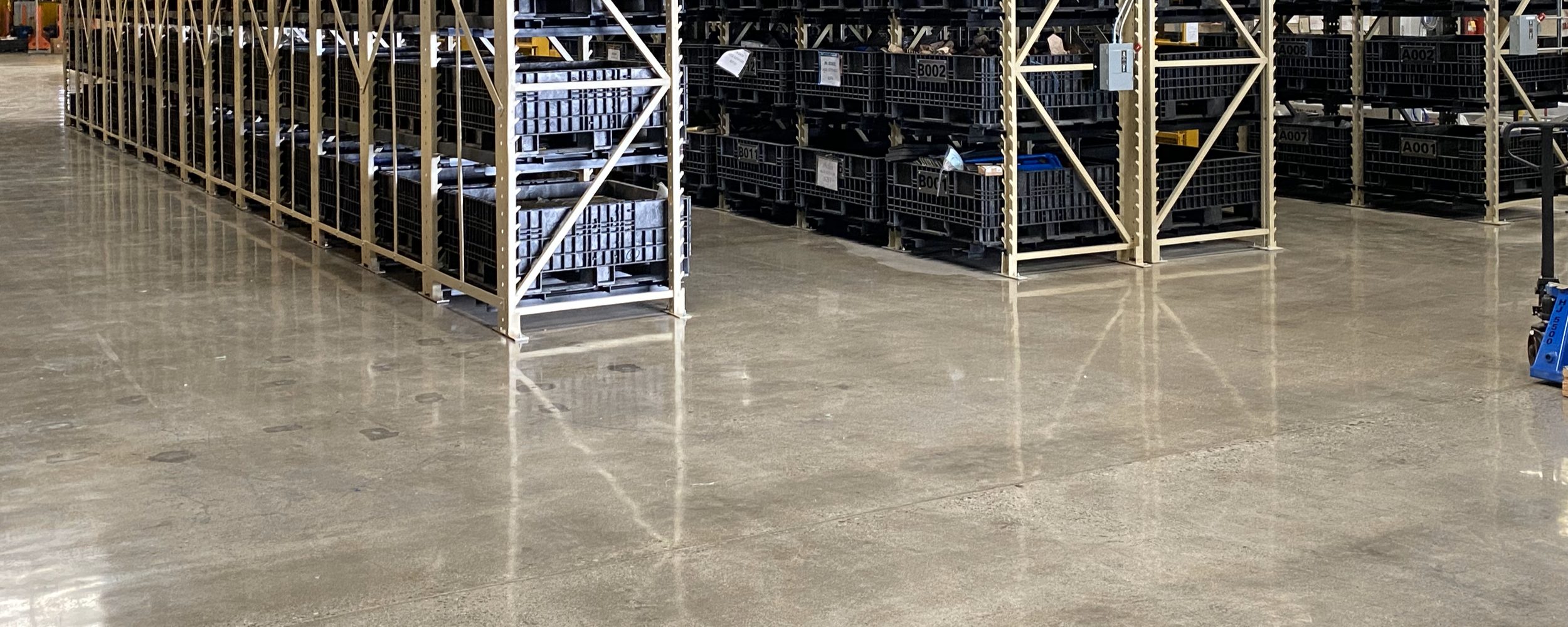
A light-colored polished concrete floor can be quite reflective, and higher surface reflectance can support daylighting and lighting-energy strategies by helping distribute light and potentially reducing the lighting load. How much depends on the color and finish of the floor, and any energy credit is modeled at the whole-building level by your design team—so treat this as a supporting factor, not a standalone point.
Durability & Life Cycle
Polished concrete uses the slab that's already there and, when maintained, holds up for many years without the replacement cycle of many applied floor coverings. That longevity reduces material consumption and waste over the building's life—a sustainability benefit that shows up in life-cycle thinking even where it isn't a single, named credit.
The Honest Version: What Polishing Actually Controls
It's worth being straight about this, because it's where a lot of marketing overpromises. On a typical project, the polishing contractor most directly influences one LEED-relevant thing: keeping the finished floor a low-emitting, coating-free surface. The recycled content and regional sourcing live in the concrete mix; the energy modeling lives with the design team; the point totals live with your LEED AP.
What polished concrete offers is a floor that aligns with a sustainable building—low-emitting when finished mechanically, durable, reflective, and made from the slab you already have—rather than a guaranteed pile of points. For a project already committed to LEED, that alignment is real and useful.
How to Approach It on an Orange County Project
- Loop in your LEED AP early: Confirm which version you're certifying under and which credits are in play
- Specify a coating-free finish where low-emitting matters: A mechanical polish keeps the floor in the inherently non-emitting category
- Coordinate with the concrete/structural scope: Recycled content and regional sourcing are mix decisions—raise them at the right stage
- Let the design team model the energy side: Provide finish and reflectance information for daylighting/lighting calculations
- Document everything: LEED runs on documentation; keep product and process records for your submittal
Sustainable Polished Concrete for Orange County Projects
Pursuing LEED or a sustainability standard on an Orange County commercial project? PolyVex Surface Solutions installs polished concrete finished to support your low-emitting and durability goals—and we'll coordinate with your LEED team on the flooring scope.
Call (714) 584-9106 Request a Consultation