
Cost-Effective Commercial Floor Solutions: How Grind & Seal Saves Facility Managers Money
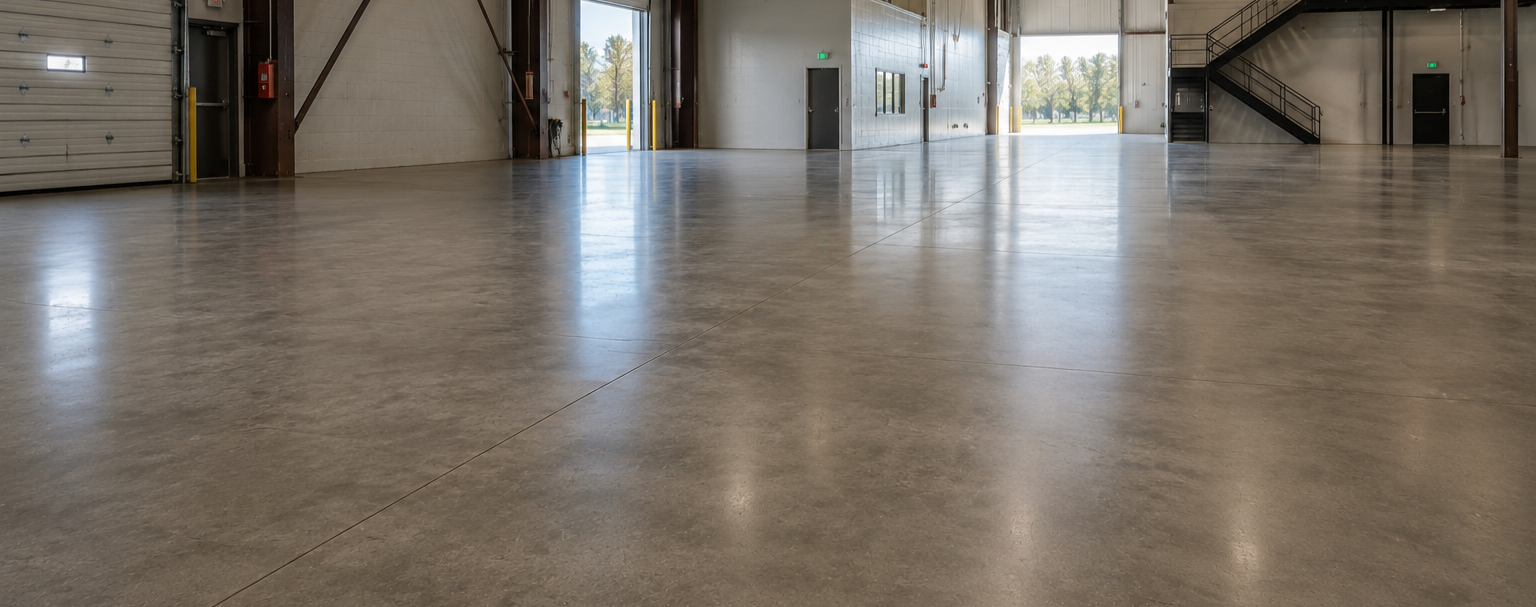
You manage several warehouses across Orange County. Every facility needs floor work, the capital budget is finite, and your CFO wants to know how to address facility condition without blowing up the number.
That's exactly the situation grind & seal is built for. It delivers real protection and a meaningfully better-looking floor without the upfront cost of epoxy or polished concrete. At PolyVex Surface Solutions, we install grind & seal for facility managers throughout Orange County—Anaheim, Santa Ana, Fullerton, and the surrounding industrial corridors—and it's frequently the right financial call. Here's an honest look at when it is, and when it isn't.
What Grind & Seal Actually Is
The process is straightforward: we mechanically grind the concrete to remove surface contamination, then apply a penetrating sealer that hardens and protects the surface.
- Diamond grinding: Removes old coatings, dirt, oils, and surface impurities
- Surface preparation: Creates a clean, uniform substrate
- Sealer application: A penetrating sealer, typically one to two coats
- Cure: Generally 48–72 hours before light traffic and about 7 days before full operation, depending on product and conditions
The result is a protected, better-looking concrete floor that's easier to clean and more resistant to moisture, dust, and minor chemical exposure. What it is not is a thick, built-up coating—grind & seal improves and protects the slab you have rather than covering it with a new wear surface.
The Real Cost Comparison
The comparison below is relative, not a quote. Actual pricing depends on slab condition, square footage, prep required, and product selected, and is provided after an on-site assessment. Service life ranges are general industry expectations and depend heavily on traffic, exposure, and maintenance.
| System | Relative Upfront Cost | Typical Service Life | Relative Cost Per Year of Service |
|---|---|---|---|
| Grind & Seal | Baseline — the lowest-cost option | ~5–8 years | Competitive |
| Epoxy Flooring | Roughly 2–3× grind & seal | ~10–15 years | Competitive |
| Polished Concrete | Roughly 2–3× grind & seal | 15+ years | Competitive — often the lowest over a long hold |
Here's the honest read on that table. On upfront cost, grind & seal is dramatically cheaper—typically somewhere in the range of 60–70% less than epoxy or polished concrete for the same footprint. On a large warehouse, that difference is substantial capital.
But once you spread each system over its actual service life, that advantage largely evens out. Longer-lasting systems distribute their cost across more years. So the strongest argument for grind & seal isn't "it's cheapest over the life of the floor"—often it isn't. The argument is capital efficiency: for a given budget, it protects roughly two to three times more square footage right now.
That distinction matters, because it tells you exactly when grind & seal is the right call.
When Grind & Seal Makes Sense
Multi-Facility Operations on a Fixed Budget
If you manage five or ten Orange County facilities, capital is the binding constraint. Grind & seal lets you address conditions across the whole portfolio instead of perfecting one building and leaving the rest untouched. For the same spend that would epoxy a couple of buildings, grind & seal can typically cover the entire group—and you can always upgrade individual properties later as budget allows.
Properties with Uncertain Long-Term Plans
If you don't know whether you'll hold or occupy a facility for five years or twenty, matching the investment to the horizon is simply good discipline. Grind & seal's 5–8 year service life aligns well with a shorter or uncertain hold, protects the floor during occupancy, and avoids over-capitalizing a building you may not keep.
Secondary Spaces and Support Areas
Not every square foot needs a premium system. A sensible mix might put epoxy or polished concrete in the primary high-traffic production or warehouse space, and grind & seal in loading docks, equipment storage, secondary warehouses, and back-of-house areas. Putting the budget where the loads and visibility actually are is usually smarter than treating the entire footprint identically.
An Illustrative Budget Scenario
The following is a hypothetical illustration of how the capital math can work—not a real project, a case study, or a promise of specific outcomes. Actual costs and results depend entirely on your properties and market.
Imagine a property company with eight warehouses, concrete visibly deteriorating across the portfolio, and a fixed capital budget for floor work this year.
- Epoxy across the portfolio: the budget realistically covers only two or three buildings. The rest continue to deteriorate for another budget cycle.
- Grind & seal across the portfolio: the same budget stretches across all eight, so every facility gets cleaned up and protected in the same cycle—with an upgrade path preserved for later.
The point isn't a guaranteed return—it's the trade-off between depth and coverage. When capital is the constraint, grind & seal buys coverage.
Durability: What to Expect
Grind & seal typically delivers around 5–8 years of service, but that range moves substantially based on conditions.
What Extends Its Life
- Lighter traffic
- Protected indoor environment
- Consistent maintenance and periodic re-sealing
- Limited chemical exposure
What Shortens It
- Heavy forklift and equipment traffic
- Oil, solvent, and chemical spills
- Standing water or high moisture exposure
- Neglected maintenance
If your facility sits firmly in the second list, that's a genuine signal to consider a heavier-duty system instead—grind & seal in a punishing environment can end up costing more through early re-work than the right system would have cost initially.
Your Decision Framework
Choose grind & seal if:
- Capital is the binding constraint
- You're managing multiple facilities and need coverage
- Your hold or occupancy horizon is uncertain, or roughly 5–8 years
- Traffic and chemical exposure are light to moderate
- You can commit to periodic maintenance
- You view it as a stepping stone toward a future upgrade
Choose epoxy or polished concrete if:
- You need 10–15+ years of service life
- Heavy equipment or chemical exposure is a daily reality
- You're planning long-term occupancy
- Appearance, flatness, or slip resistance is critical
- The budget supports the higher upfront investment
How to Decide for Your Orange County Facility
- Inventory your properties: Square footage, condition, and traffic intensity for each
- Confirm your horizon: How long will you hold or occupy each building?
- Assess exposure honestly: Forklift traffic, chemicals, and moisture drive the system choice
- Zone the portfolio: Premium systems where loads and visibility justify them; grind & seal elsewhere
- Get scoped estimates: Real numbers for your slabs, not rules of thumb
Free Orange County Grind & Seal Assessment
Working within a tight facility budget? PolyVex Surface Solutions will assess your Orange County properties and scope a cost-effective flooring plan—honest about where grind & seal fits and where it doesn't.
Call (714) 584-9106 Request a Free Assessment