

Logistics Hub Efficiency: How Flooring Affects Throughput in Orange County Facilities
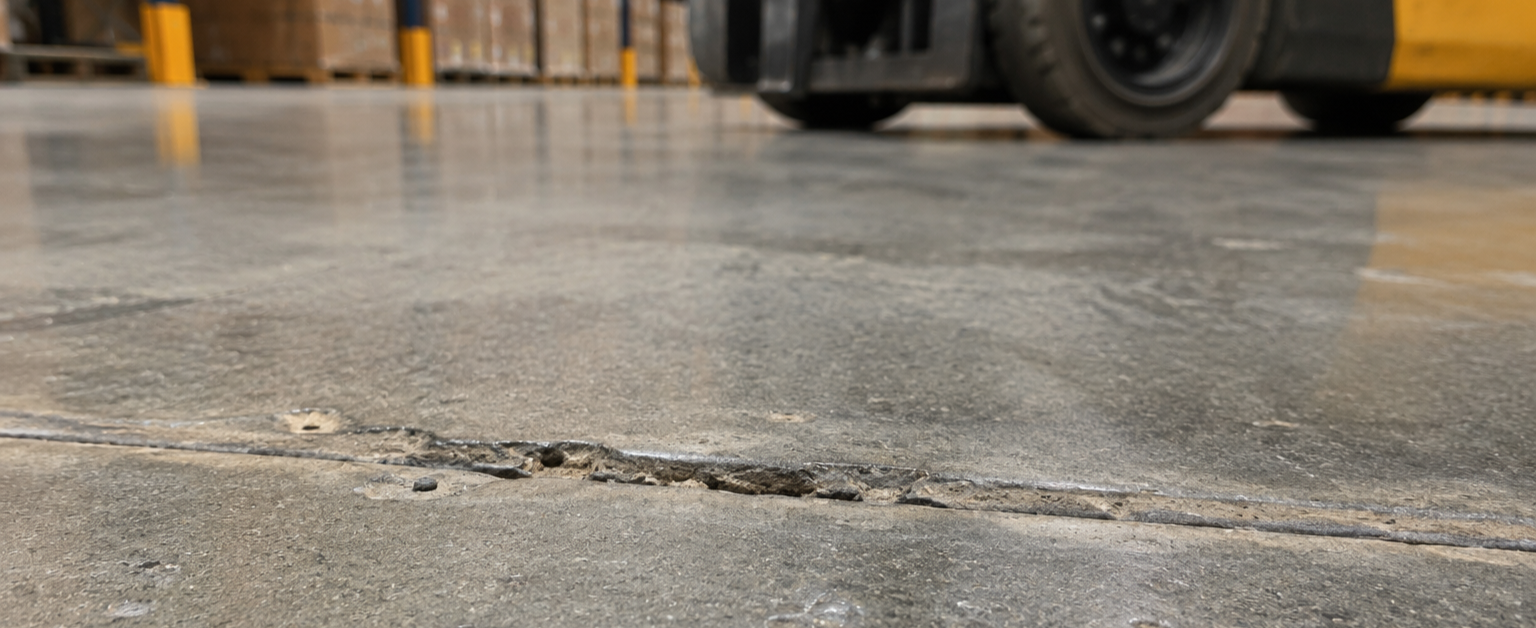
In a logistics operation, throughput is everything—and the floor your equipment runs on is a quiet variable that either supports the flow or drags on it. A rough, dusty, or worn slab slows forklifts, stresses automated equipment, and creates the kind of friction that compounds across thousands of daily moves.
Orange County is dense with distribution and fulfillment operations, and the ones that run efficiently tend to treat the floor as part of the material-handling system, not just the surface underneath it. At PolyVex Surface Solutions, we help logistics operators across Orange County—Anaheim, Santa Ana, Fullerton, and the surrounding industrial corridors—specify and restore floors that keep equipment moving. Here's how flooring affects throughput, and where it's worth attention.
How the Floor Affects Equipment Performance
Every piece of material-handling equipment in your facility interacts with the floor thousands of times a day. The surface condition shapes how fast and how reliably that equipment can operate:
- Forklifts and reach trucks move faster and more safely on a smooth, predictable surface. Cracks, spalled joints, and uneven areas force operators to slow down, and they accelerate tire and component wear.
- Pallet jacks and carts roll with less effort on a sealed, level floor, which matters over a full shift of repetitive moves.
- Automated equipment (AGVs, AMRs, and very-narrow-aisle systems) is the most sensitive of all—more on that below.
None of this is dramatic on any single trip. The impact is cumulative: small amounts of slowing, braking, and rerouting, multiplied across every move, every aisle, every shift.
Surface Flatness and Automated Operations
Floor flatness is the specification that matters most for automation and high-reach operations. Flatness and levelness are commonly measured using F-numbers (FF for flatness, FL for levelness) under standards like ASTM E1155, with ACI 302 providing guidance on appropriate classes for different uses.
Why it matters for throughput:
- AGVs and AMRs rely on consistent contact and, in some systems, navigation cues that a rough or deviating surface can disrupt. A floor outside the intended flatness range can cause automated vehicles to slow, hesitate, or fault.
- Very-narrow-aisle (VNA) turret trucks operating at height are especially sensitive to floor flatness—small deviations at floor level translate into larger sway at the top of a lift, which forces slower, more cautious operation.
- High racking generally performs best over a floor that holds tight, defined-traffic flatness in the aisles.
The practical point: if you're running or planning automation or VNA racking, the floor's flatness is a throughput input, not an afterthought. Flatness targets are project-specific and set by the equipment and layout—an assessment establishes what your aisles actually need versus what they currently have.
Dust and Contamination: The Hidden Efficiency Drain
Bare or deteriorating concrete "dusts"—it sheds fine particles under traffic. In a logistics setting that creates several efficiency problems:
- Dust settles on products, packaging, and racking, creating cleaning work and potential quality issues for sensitive goods
- Fine particulate can foul sensors, wheels, and moving parts on automated and powered equipment, increasing maintenance
- A dusty floor is harder to keep clean, which compounds over time
Sealing or coating the floor largely eliminates dusting, which keeps the environment cleaner, protects equipment, and reduces the housekeeping burden—all of which quietly support uptime.
Wear Patterns and Material-Handling Reliability
Floors wear where the traffic concentrates: main travel lanes, dock approaches, turning points, and control joints. Left unaddressed, that wear becomes a throughput problem:
- Spalled or damaged joints jolt equipment and loads, force operators to slow, and can damage wheels over time
- Potholes and surface breakdown in travel lanes create bottlenecks and reroute traffic
- Worn markings blur traffic flow and slow decision-making at intersections
Targeted repair—joint treatment, spall repair, and re-coating high-traffic lanes—restores a consistent running surface where it matters most, often without touching the entire floor.
An Illustrative Throughput Example
The following is a simplified, hypothetical illustration to show how small per-move effects can add up. It is not a measured result or a promise of specific gains—your actual impact depends on your equipment, layout, and current floor condition.
Consider a facility whose operators shave a small amount off travel speed to navigate rough joints and worn lanes, and whose automated units occasionally slow or fault over an out-of-tolerance surface. None of that is significant on one trip. But throughput is the sum of thousands of trips per shift—so even a modest, consistent reduction in friction across every move can be meaningful over a day, a week, a peak season. That's the logic behind treating the floor as part of the material-handling system: the gains are incremental per move but they accumulate at scale. To know what's realistic for your operation, you'd measure your own lanes and equipment behavior rather than assume a number.
Matching Flooring to Logistics Needs
Cost ranges are typical PolyVex estimates for Orange County projects and vary with slab condition, square footage, prep, and finish. We scope and quote each facility individually.
| Priority | Recommended Approach | Typical Range |
|---|---|---|
| Durability & flatness under equipment | Polished concrete | ~$5–$9/sq ft |
| Dust control & cleanability | Grind & seal | ~$2–$4/sq ft |
| Chemical/wear resistance in heavy lanes | Epoxy / resin coating | ~$5–$9/sq ft |
| Restoring damaged travel lanes & joints | Targeted concrete & joint repair | Quoted after assessment |
An Orange County Logistics Floor Checklist
- Map your traffic: Identify the main lanes, dock approaches, VNA/automation aisles, and turning points
- Assess flatness where it counts: Especially in automation and high-reach aisles
- Find the friction: Damaged joints, worn lanes, dusting areas, and faded markings
- Prioritize high-traffic zones: Fix where the moves concentrate for the biggest effect
- Match finish to function: Flatness and durability for equipment lanes, dust control for cleanliness
- Plan around operations: Phase the work to avoid disrupting throughput
Free Orange County Logistics Floor Assessment
Rough joints, dusting concrete, or floors that slow your equipment? PolyVex Surface Solutions will assess your Orange County facility and recommend flooring and repair options that support throughput—scoped and phased around your operation.
Call (714) 584-9106 Request an Efficiency Assessment