
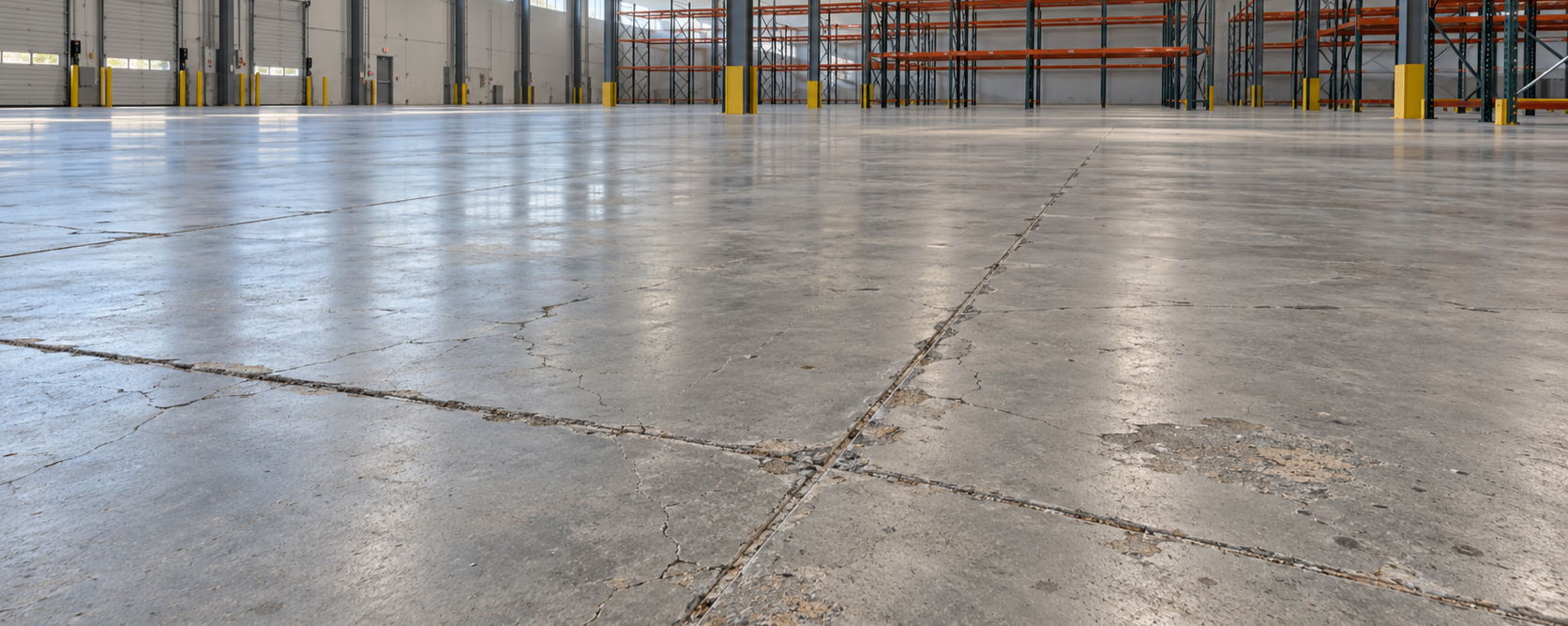
If you manage a warehouse, retail space or industrial building in Orange County and the concrete floor is cracking, spalling or wearing through, the first question is usually whether it can be repaired or has to be torn out and replaced. In most cases, the slab can be repaired and protected for far less cost and downtime than replacement.
At PolyVex Surface Solutions, a commercial concrete coatings and floor repair contractor based in Placentia, we assess floors across Orange County, from Anaheim and Fullerton industrial parks to Irvine, Santa Ana and Tustin business centers. This guide explains how to tell a repairable floor from one that needs replacement, what each path involves, and how to make the call with confidence.
Should You Repair or Replace a Commercial Concrete Floor?
Repair is the right choice when the slab itself is structurally sound and the problems are at or near the surface: cracks that are not moving, damaged control joints, spalled edges, a dusting or worn surface, stains, or a failed coating. Repair, followed by a protective finish such as grind and seal, polished concrete or an epoxy coating, restores the floor without demolition.
Replacement is usually needed when the slab has failed structurally: widespread settlement or heaving, large sections that rock or sound hollow, cracks with vertical offset that keep growing, or a slab that is too thin or weak for the loads now on it. Those conditions should be confirmed by a structural or geotechnical engineer before any decision is made.
Signs Your Floor Can Be Repaired
Many aging Orange County commercial floors fall into this group. Common repairable conditions include:
- Hairline and shrinkage cracks that are stable and not widening
- Broken or spalled control joints, often worn down by forklift and pallet-jack wheels
- Spalling and pitting where the top layer of concrete has chipped or flaked away
- Dusting or a worn surface that leaves powder on equipment and product
- Small lips or uneven edges at joints and cracks that can be ground flush
- Peeling or worn-through coatings from a previous epoxy or paint system
- Oil, chemical or tire stains on the surface
These problems do not mean the slab is failing. They mean the surface needs repair and protection before the damage spreads.
Signs Replacement May Be Necessary
Replacement becomes the realistic option when the problem is below the surface. Warning signs include:
- Settlement or sinking across large areas, often from poor subgrade compaction or soil movement
- Heaving, where sections of slab have lifted
- Active structural cracks with one side higher than the other that continue to grow after repair
- Hollow-sounding or rocking sections that suggest voids underneath
- Severe deterioration through the full depth of the slab, such as crumbling concrete or badly corroded reinforcing steel
- A change in use that puts heavier loads on a slab that was not designed for them
If you see these signs, have an engineer evaluate the slab. Sometimes only a section needs to be removed and re-poured, and the rest of the floor can still be repaired and coated to match.
Repair vs. Replacement at a Glance
| Factor | Repair and resurface | Full slab replacement |
|---|---|---|
| Relative cost | Typically a fraction of replacement | Highest: demolition, haul-off, new concrete and finishing |
| Downtime | Often days, and can be phased zone by zone | Weeks, plus cure time before a coating can go down |
| Disruption | Dust-controlled grinding and repair; racking can often stay in place in other zones | Area must be fully cleared; heavy equipment and demolition noise |
| Best fit | Structurally sound slab with surface damage | Structural failure confirmed by an engineer |
| Finish options afterward | Grind and seal, polished concrete, epoxy or metallic coatings | Same options, once the new slab has cured and passed moisture testing |
Cost and schedule comparisons are general and relative. Actual scope depends on slab condition, square footage, access and the finish selected; an on-site assessment is the only way to price a specific floor.
How Commercial Concrete Floor Repair Works
A typical repair project from PolyVex Surface Solutions follows a clear sequence:
1. Assessment and moisture testing
We walk the floor, map cracks and damaged joints, check for movement, and test moisture levels. Moisture coming up through a slab on grade is one of the most common reasons coatings fail, so testing comes before any product is chosen.
2. Crack, joint and spall repair
Cracks are routed and filled, damaged joints are rebuilt with semi-rigid filler that supports wheel traffic, and spalled areas are patched with repair mortar. Learn more about our commercial concrete repair services in Orange County.
3. Surface preparation
The floor is diamond-ground to remove old coatings, contamination and lips, and to open the surface so the new finish bonds properly.
4. Protective finish
The right finish depends on how the space is used:
- Grind and seal for warehouses and back-of-house areas that need a durable, dust-free floor on a tighter budget
- Polished concrete for distribution centers, retail and showrooms that want a long-lasting, low-maintenance surface
- Epoxy coatings where chemical resistance, color, safety striping or a seamless surface matters
Orange County Factors That Affect the Decision
Many of the warehouses and flex buildings in Anaheim, Santa Ana, Fullerton, Orange and Irvine have been in service for decades, and their floors carry years of forklift traffic, racking loads and earlier coating jobs. A few local factors are worth weighing:
- Operating schedules: distribution and logistics tenants often cannot shut down. Repair work can be phased by zone or scheduled for nights and weekends; replacement usually cannot.
- Lease responsibility: whether the landlord or tenant pays for floor repair versus replacement depends on the lease. Confirm with your lease documents and your attorney; we are a flooring contractor, not a legal advisor.
- Soil and settlement: some parts of Southern California have soils that shrink and swell with moisture. If settlement is part of the problem, an engineer should confirm the cause before a new slab is poured.
- Turnover timing: between tenants is often the best time for floor work, because the space can be fully cleared.
Your Next Steps
- Photograph the problem areas and note when you first saw them and whether they are getting worse.
- Check for movement: mark the ends of a crack and look again in a few weeks. A crack that grows needs closer evaluation.
- Schedule an on-site assessment so moisture, joints and cracks can be checked in person.
- Bring in an engineer if there are signs of settlement, heaving or structural cracking.
- Plan the work around operations, using phased zones or a tenant turnover window where possible.
If replacement is the answer, a concrete contractor will pour the new slab, and PolyVex Surface Solutions can polish or coat it once it has cured and passed moisture testing. If repair is the answer, we can usually handle the whole job, from crack and joint repair to the finished floor.
Not Sure Whether Your Orange County Floor Needs Repair or Replacement?
PolyVex Surface Solutions provides on-site assessments and free quotes for commercial concrete floor repair, grind and seal, polished concrete and epoxy coatings across Orange County.
Call (714) 584-9106 Request a Free Quote